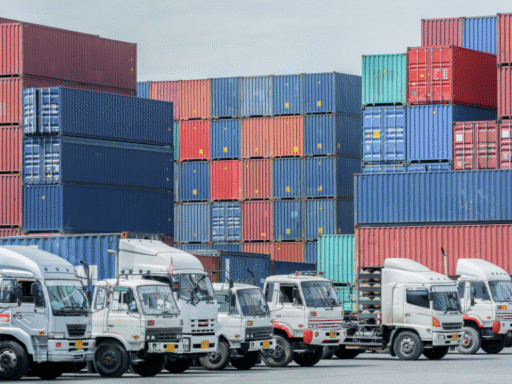



Logistics startups in India are drawing investor interest with tech, scale, and innovation. Here’s how they’re reshaping and why the funding boom matters. Once unorganized in its past, this sector has undergone a complete overhaul in recent years. The supply chain, once considered a support function, has now come to be known as the backbone of India’s digital commerce economy, and startups are at the forefront of this transformation.
From the blistering pace of growth of the e-commerce and D2C brands to the aggressive road development under government schemes such as Gati Shakti and the National Logistics Policy, India’s logistics landscape has never been so promising before. And wherever there is a promise, the investment will never be too far behind.
The E-Commerce Boom and Demand for Speed
At the eroding core of such investor attraction stands one undeniable fact about the country-USA; the trade in India has never been so huge. With millions of consumers buying online and expecting quick delivery in metros and Tier-3 towns alike, the pressure on logistics infrastructure has exploded.
Early to grasp the shift were startups like Delhivery, Ecom Express, and Shiprocket: they built their models around tech-enabled tracking, an optimized last-mile delivery system, same-day/next-day shipping, and even route planning implemented via AI. It is this kind of innovation, coupled with scalability, that attracts investments.
Investors are in for companies that not only solve logistical pain points but also do so with a promise to scale on a national and, probably, global basis.
Technology: The Game-Changer Investors Love
Modern logistics startups are fundamentally different from traditional transporters. They are building a digital-first supply chain ecosystem instead of just transporting a few packages.
Real-time GPS tracking, AI-based warehouse management, IoT-vehicle health monitoring, EV integration, and blockchain-based traceability are just some of the technologies that these startups employ to improve transparency and reduce inefficiencies.
This is exactly what investors want: data-driven decision-making, automation, and innovation. All these factors diminish business risks and build up a roadmap to profitability, which investors care about immensely.
The Role of Policy & Infrastructure Push
Government initiatives such as PM Gati Shakti, National Logistics Policy (NLP), and Unified Logistics Interface Platform (ULIP) have provided an enabling environment for logistics startups to scale and integrate into the national infrastructure.
The sector that earlier used to have several compliance bottlenecks is now being supported at the policy level for digitization, multimodal connectivity, and ease of doing business. Investors take this policy alignment as a positive macro-signal, an endorsement that logistics in India will be a full-term bet.
A Surge in Startup Funding and Big Names Entering the Scene
In recent years, logistics startups have seen record levels of venture capital and private equity funding. Startups like:
- Delhivery raised over $1 billion before its IPO
- Shiprocket attracted funding from Temasek and Lightrock
- Porter and ElasticRun have received multi-million-dollar backing from global investors
- Xpressbees secured investments from Blackstone and Norwest Venture Partners
Even larger tech companies like Flipkart, Amazon, and Reliance are investing in logistics capabilities either through acquisitions or internal innovations. It’s clear: logistics is the new startup goldmine.
 Why Investors Are Betting Big
 Why Investors Are Betting Big
So, what’s fueling this surge in interest?
It comes down to a mix of strong fundamentals and emerging market opportunities:
- High growth potential: India’s logistics market is expected to hit $400 billion by 2030
- Low-tech penetration in Tier 2/3 cities: Startups are solving real-world last-mile problems in untapped markets
- Scalable, repeatable models: Logistics can be replicated across geographies, increasing investor confidence
- Sustainability: Startups integrating EVs, green warehouses, and carbon tracking are catching ESG-focused investors’ eyes
- Data advantage: With every shipment tracked and analyzed, logistics companies build valuable datasets that improve efficiency and valuations
Challenges Still Remain-but Startups Are Tackling Them
Although in the news, the Indian logistics space confronts certain challenges: fragmented supply chain forces, absent proper warehousing, restrictive regulations, and surging fuel costs. The very hurdles, however, have turned into opportunities for startups that pique investor interest.
They are creating micro-fulfillment centers, cloud logistics platforms, hybrid fleet models, or collaborative delivery networks to cut down on wastage in terms of the cost per shipment.
In a nutshell, they are not building logistics companies. They are building resilient ecosystems.
The Road Ahead Looks Funded and Fast
India’s logistics startups are no longer just delivery partners; they’re strategic enablers of economic growth. With technology as their wheel and investor capital as fuel, they’re transforming how goods move across the country.
And for investors, the signal is clear: logistics is no longer just about trucks and warehouses. It’s about data, speed, visibility, and future-ready infrastructure. The more these startups innovate, the more India moves, and the more capital moves in their direction.